The EU mandatory withdrawal button: How to comply
On 19 June 2026, a requirement came into effect stating that every ecommerce business selling to consumers in the EU must provide a prominent, easy-to-use online withdrawal function on their website. Under Directive (EU) 2023/2673, online merchants must ensure that customers can cancel their contracts via a simple, two-step electronic process. If your store serves buyers in the European Union, you must implement these design and legal requirements to avoid substantial non-compliance penalties.
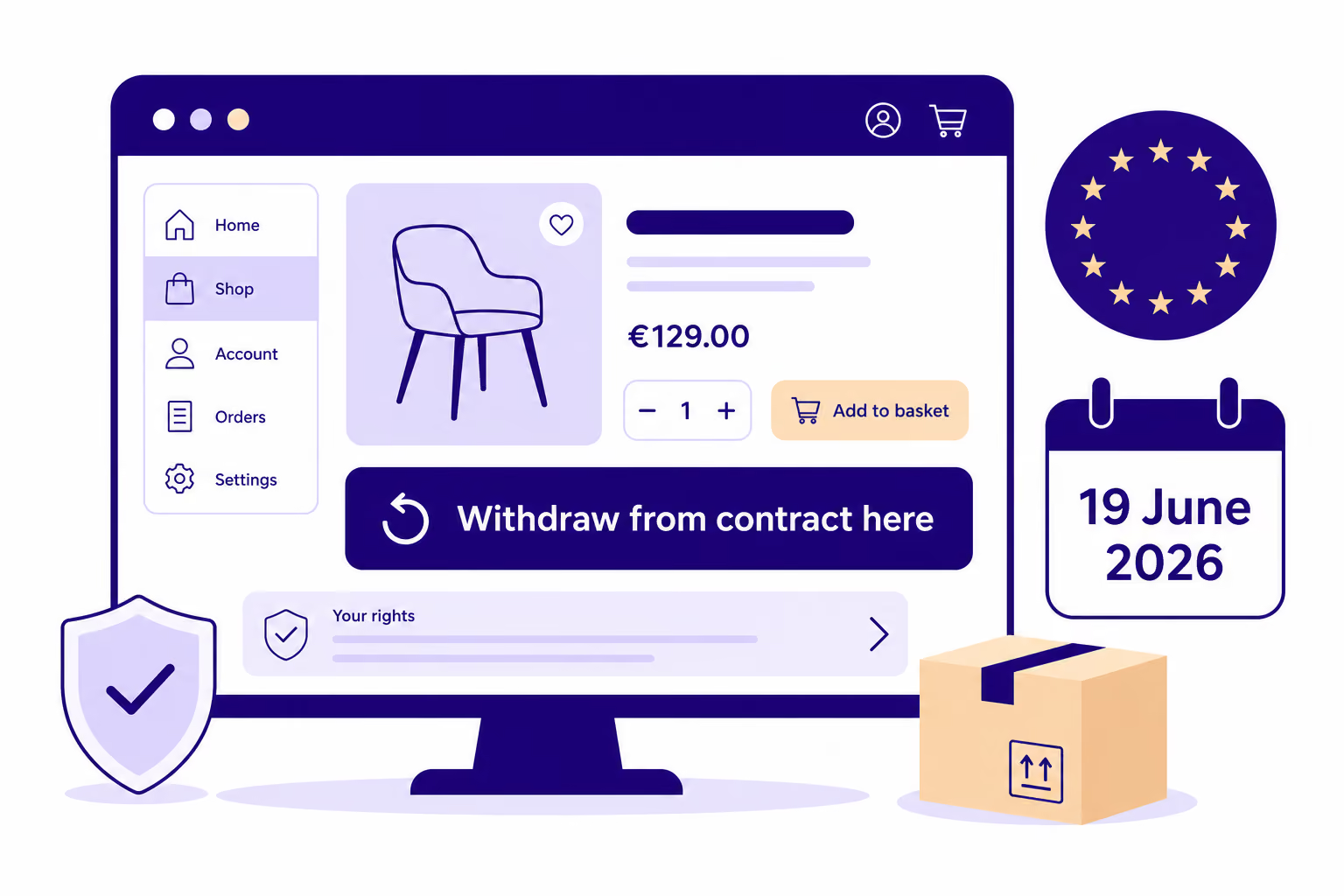
You might worry that adding a prominent cancellation button will spike your return rates and hurt your profit margins. While this is a valid concern, practice shows that making the cancellation process transparent actually builds buyer confidence. Nordic and Baltic shoppers value frictionless experiences. A clear, easy-to-find cancellation flow lowers your support workload, prevents costly payment chargebacks, and reassures customers. A customer-centric approach can actively boost sales. As outlined in our guide on how a return policy can make or break your online store, clarity and transparency reduce checkout hesitation.
Who must implement the withdrawal button
The new law applies to all business-to-consumer (B2C) distance contracts concluded online where a statutory right of withdrawal exists. If you sell goods, services, or digital content to consumers located within the EU, this requirement applies to your store. This includes cross-border sellers registered outside the EU who direct their activities to European buyers.
The mandate does not apply to:
- Pure business-to-business (B2B) transactions
- Contracts concluded via email, telephone, or post
- Websites that function as directories or catalogues but do not allow checkout
Additionally, you do not need to show the withdrawal button for products that fall under standard consumer law exceptions.
Common contract exceptions
- Customised or personalised goods
- Perishable items with a short shelf life
- Sealed hygiene or health products opened after delivery
- Digital services already fully performed with prior consumer consent
- Time-sensitive services like transport, accommodation, or car hire
Two-step design specifications
The law requires a clear, non-manipulative, two-step user flow. You must avoid hidden menus, confusing navigation, or manipulative interface patterns that make finding or using the button difficult.
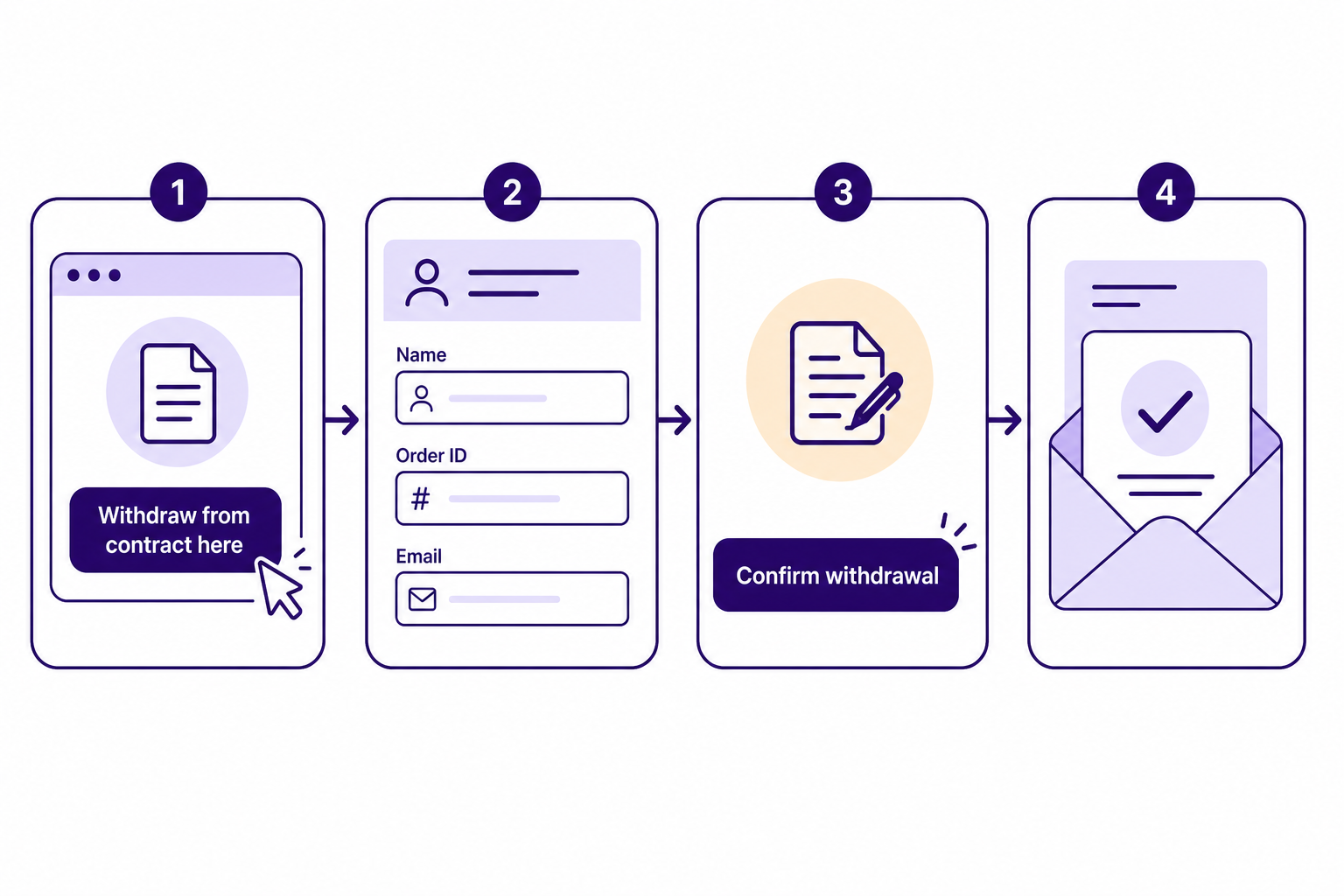
- Entry point link
- Simple form
- Confirmation button
The entry point
The button or link must be continuously available to the customer throughout the 14-day statutory withdrawal period. It must be prominently displayed on the website, easily accessible from all relevant sub-pages, and visually distinguished from standard footer links.
The entry link must have a clear, unambiguous phrase, such as "Withdraw from contract here" or, in e-commerce, rather "Return product," so that it is immediately clear to customers what it entails.
The landing form
Clicking the entry link must take the customer to a simple web form. To prevent merchants from creating artificial barriers, you may only ask for the following essential details:
- The consumer's name
- Information identifying the contract, such as an order number
- The consumer's electronic address for confirmation of receipt
You cannot make submitting the form conditional on filling out feedback surveys, providing a reason for the return, or adding a phone number.
The confirmation step
To submit the form, the user must click a second, clearly identifiable button. This final button must be labelled with the phrase "confirm withdrawal from contract" or a corresponding translation.
Once submitted, your system must automatically and without undue delay send an email receipt to the customer. This receipt must reproduce the contents of their submission along with the exact date and time it was received.
Regional language requirements
To comply with the directive, the button labels must match the local language of the consumer. The table below lists the approved legal phrases for the Baltic, Polish, and Finnish markets. While the exact wording can be slightly adjusted, it is important that the core meaning remains the same and unambiguous.
Timelines and consequences of non-compliance
National transposition timelines vary by country. In Lithuania, the withdrawal button requirement already applies from 19 June 2026. In Estonia, it becomes mandatory from 1 September 2026. In Latvia, the implementing legislation is still going through parliament; once it is adopted, the requirement will take effect immediately, so Latvian merchants should have their withdrawal button ready in advance. In Finland, the requirement has applied since 19 June 2026.
Failing to implement the button or neglecting to inform consumers about its placement carries severe legal consequences:
Extended withdrawal period: If you fail to inform the consumer about their right of withdrawal, the standard 14-day return window is automatically extended by an additional 12 months. This means buyers legally have the right to return items and demand full refunds for up to a year and 14 days.
National consumer protection authorities also have the power to issue injunctions, order businesses to cease non-compliant operations, and levy fines. Even if your website is missing the button, consumers retain their legal right to withdraw by sending a standard email, support ticket, or chat message.
Operationalising refunds in your backend
Adding the new button means your store's backend systems must be ready to process cancellation requests faster and more comfortably. Under EU rules, payments made by the consumer must be reimbursed immediately, but no later than 14 days after receiving the withdrawal application.
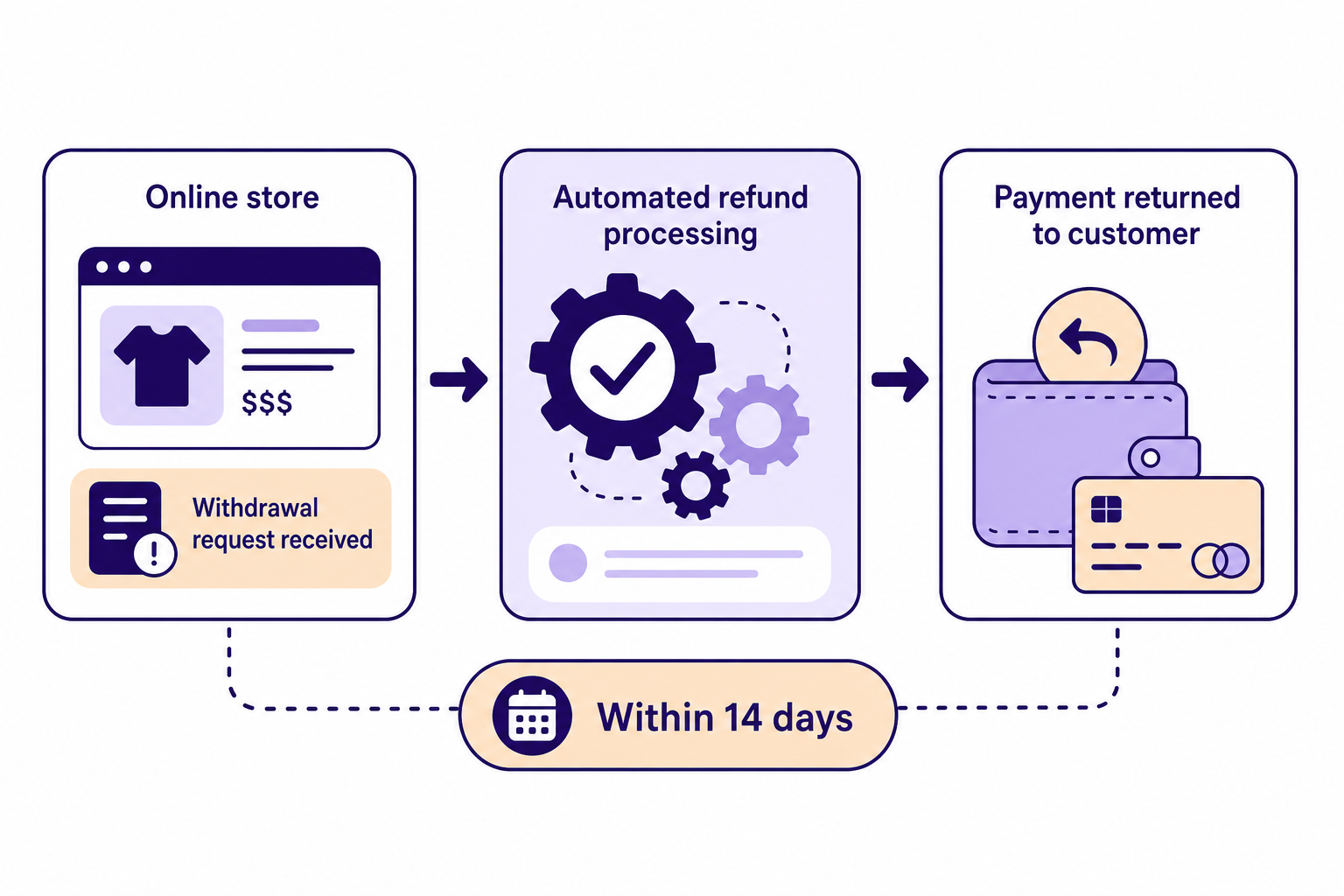
This is where automation becomes vital. Handling refunds manually through separate banking portals takes hours and increases human error. If you are selling across regional markets, such as Estonia, you likely navigate specific localised shipping and payment methods. As detailed in our guide on selling online in Estonia, managing these flows in one central hub is key to efficient scaling.
To streamline this workflow, you can handle your payouts and returns automatically. With automated refund processing, you can process customer refunds in seconds directly from your store admin, Partner System, or API. This simplifies compliance and ensures your customers get their money back on time, keeping you in full alignment with the new EU rules.
For more tips on setting up a seamless checkout and returns flow, explore our checklist on ecommerce return policy best practices.
Adapting to the new EU directive doesn't have to disrupt your business. By combining a clear and user-friendly withdrawal flow with an automated backend system, you protect your ecommerce store from fines while building consumer trust. Partner with Montonio today to upgrade your checkout, automate shipping, and bring your business seamlessly in line with the new rules.