Open banking payments explained for online merchants
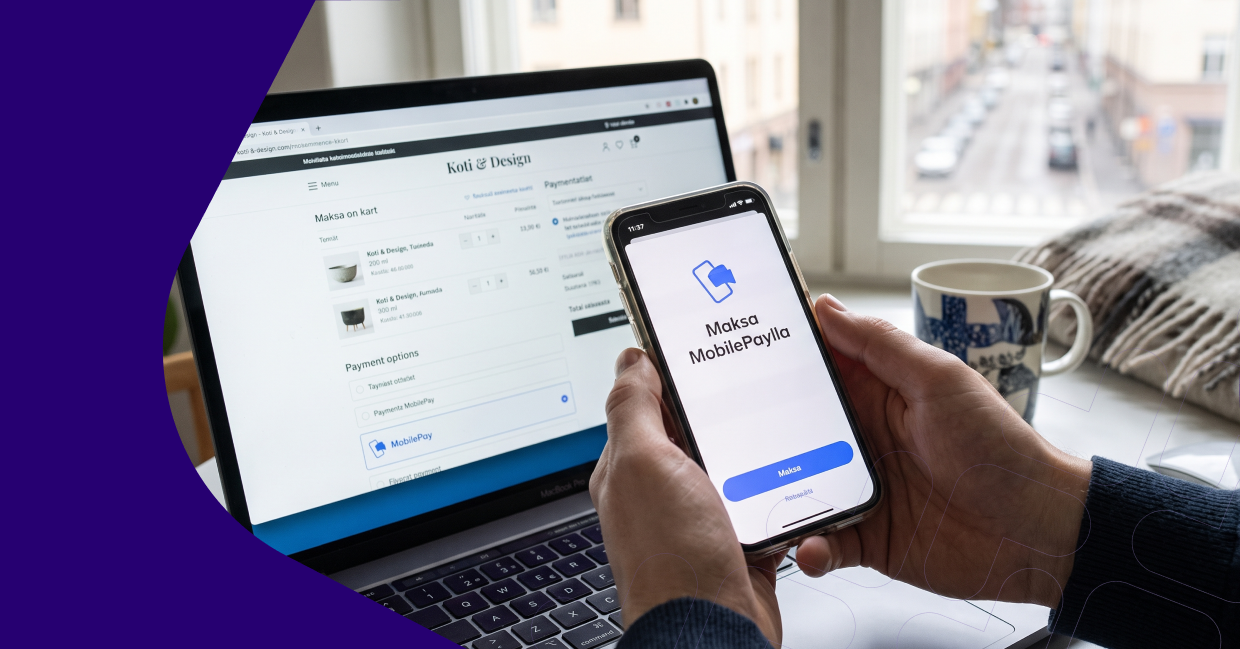
Open banking payments – often called pay-by-bank or just bank payments – allow your customers to pay for goods directly from their bank accounts. This account-to-account (A2A) method bypasses traditional card networks, dramatically reducing processing fees and settlement times. While this approach offers clear economic advantages, adopting it requires understanding how it handles transaction finality and checkout friction.
What are open banking payments?
Open banking is a secure framework that allows third-party financial providers to access banking data and initiate payments on behalf of consumers, provided the consumer gives explicit consent. In Europe, this ecosystem is regulated under the PSD2 framework, while other regions are introducing similar guidelines, such as the Consumer Financial Protection Bureau's Section 1033 rule in the US.
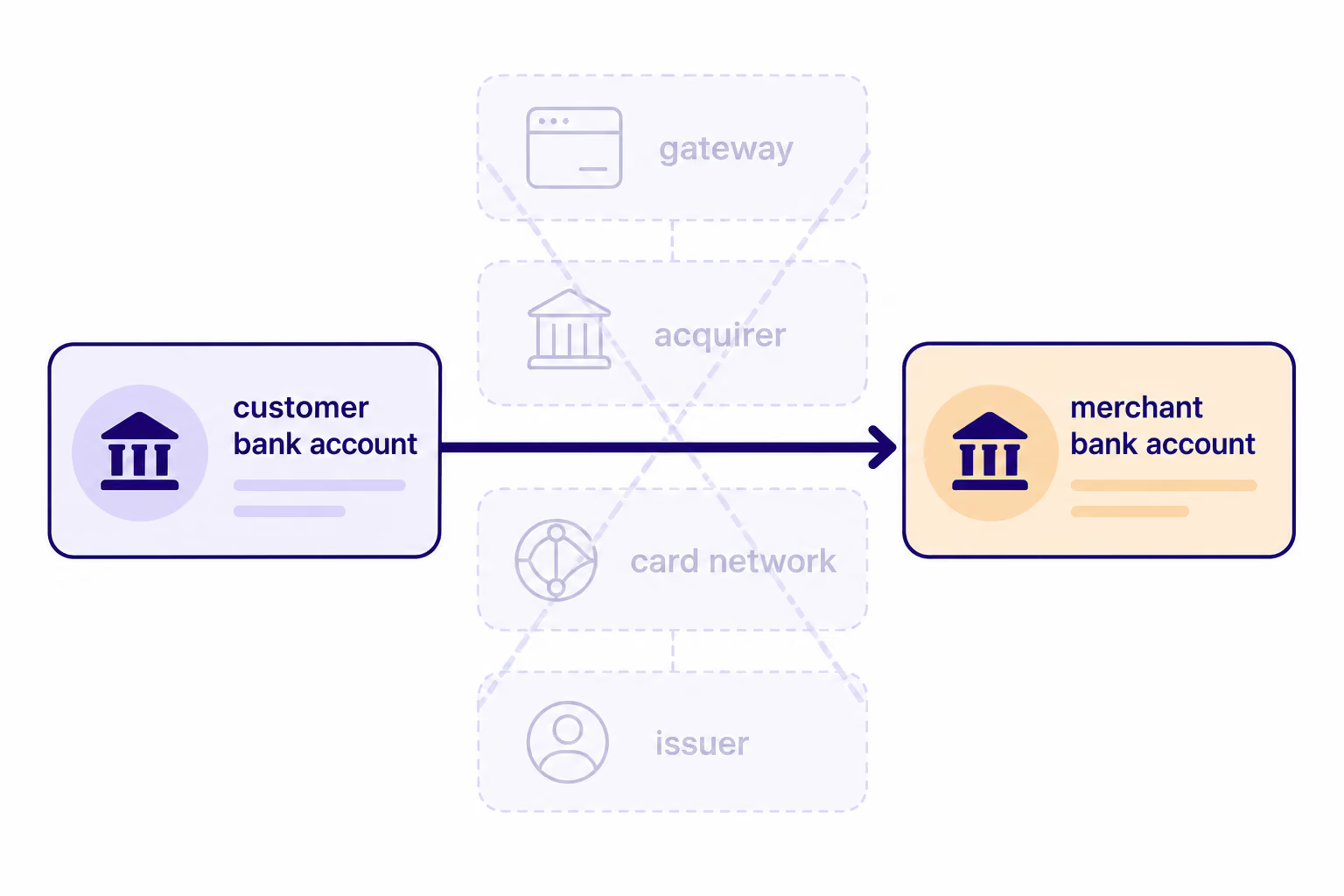
Historically, online purchases relied on credit and debit card rails. These systems require multiple intermediaries, including payment gateways, acquiring banks, card networks, and issuing banks. To understand how this works, you can read our guide on how payment gateways work.
Open banking simplifies this pipeline by establishing a direct digital connection between the merchant's bank account and the customer's bank account. This direct route cuts out the middle layers, lowering transactional overheads and reducing the risk of card fraud.
How open banking works at checkout
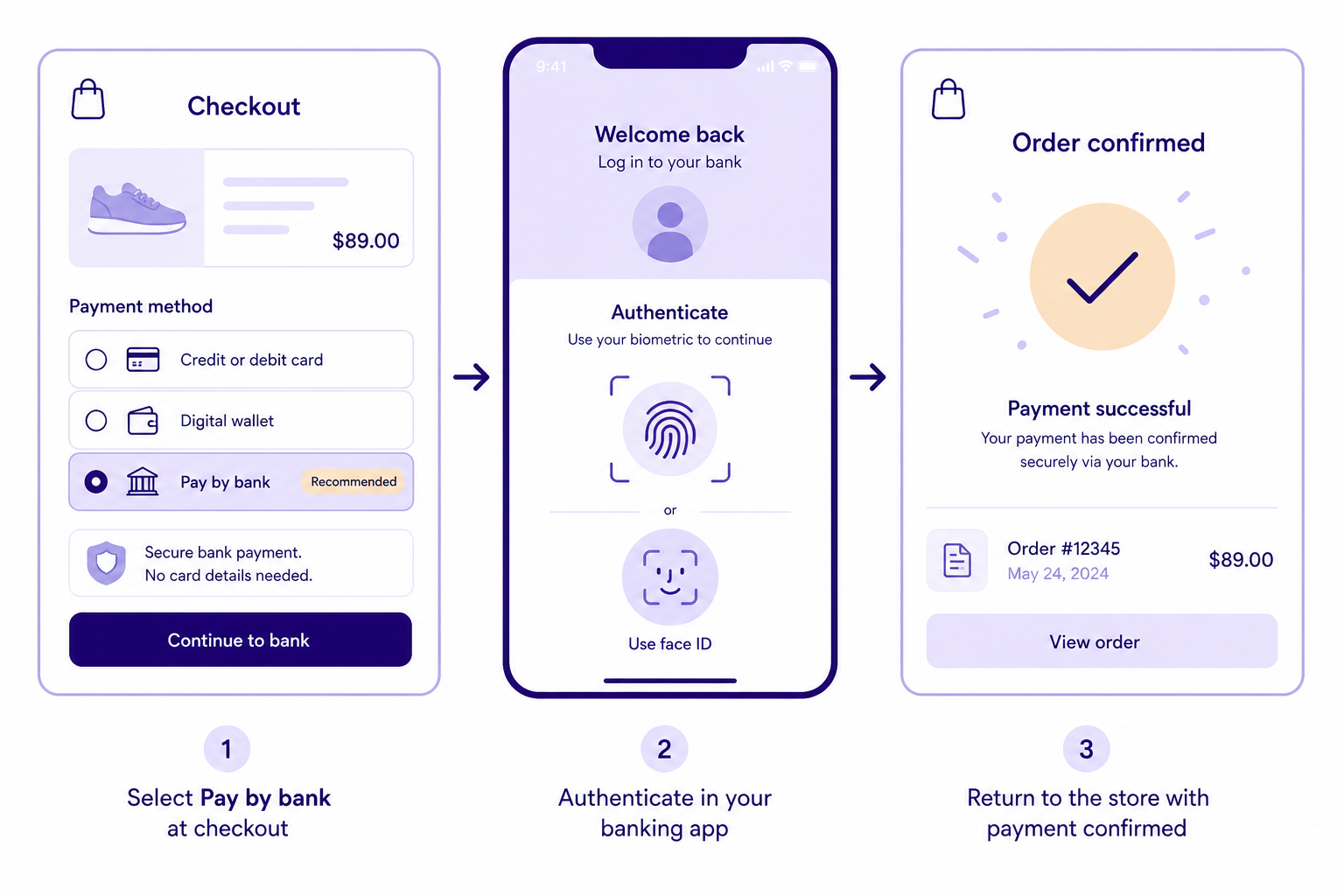
For a shopper, the open banking payment flow is integrated directly into the standard checkout process. The typical flow involves the following steps:
- The customer selects pay-by-bank or chooses their specific bank logo at your checkout screen.
- The payment gateway securely redirects the customer to their mobile banking app or online banking portal.
- The customer authenticates the transaction using their bank's native security protocols, such as facial recognition, fingerprint scanning, or a passcode.
- The customer approves the pre-filled payment details, which include the exact amount and merchant recipient information, with a single tap.
- The customer is redirected back to your online store, where the transaction is instantly confirmed.
This flow uses strong customer authentication (SCA) natively, ensuring that security is built directly into the consumer's log-in process.
Key benefits of open banking
Moving away from legacy card rails offers several distinct advantages for online businesses, particularly regarding operating margins and cash flow.
Direct cost savings
Traditional card transactions can cost merchants anywhere from 1.5% to 5% of the transaction value. Open banking providers typically charge a lower fee structure, often between 1% and 1.5% plus a small flat fee, which on average costs about 50% less than card processing. These savings are particularly noticeable on high-value transactions or business-to-business sales where percentage-based card fees quickly add up.
Faster access to funds
With standard card payments, settlements can take several business days to reach your account. Open banking payments run on instant settlement networks – such as SEPA Instant in Europe, or RTP and FedNow in the US. These real-time networks allow funds to be credited to your bank account almost instantly, providing immediate liquidity and improving daily operational cash flow.
Streamlined reconciliation
Matching card payments to specific orders at the end of the month can be a manual, error-prone task. Open banking payments transmit detailed metadata directly alongside the transaction. This structured data allows accounting systems to automatically match each payment to its corresponding order, reducing manual back-office tasks and billing errors.
Risks and challenges to consider
To make an objective decision about open banking, you must weigh its clear financial benefits against its distinct operational challenges.
The friction trade-off
While card payments carry higher fees, they are highly convenient. Many users have their credit card details saved in browser autofill or digital wallets, allowing them to complete a purchase in seconds.
Open banking requires customers to redirect to their banking app and authorise the transfer. If a customer does not have their banking app installed or cannot remember their login credentials, this extra step can lead to checkout abandonment.
Payment finality and fraud profiles
The risk profile of open banking depends heavily on the underlying payment rail:
- Older bank transfer methods, like ACH in the US, are subject to reversals and returns due to issues like insufficient funds, which can take several days to settle.
- Instant rails, such as SEPA Instant in Europe or FedNow in the US, are irrevocable once authorised, completely eliminating chargeback risk for merchants.
However, this finality introduces a different security risk. If a bad actor uses social engineering or phishing to trick a customer into authorising an instant payment, the transaction cannot be undone on the network level. Merchants must therefore monitor their checkout environments to prevent unauthorised access.
To better understand how these dynamics fit together, you can read our analysis of why card payments are still important in ecommerce.
Evaluating the technology for your store
When picking an ecommerce payment provider, you do not have to choose between cards and open banking. Most successful online stores adopt a hybrid approach, offering both options to cater to different customer preferences.
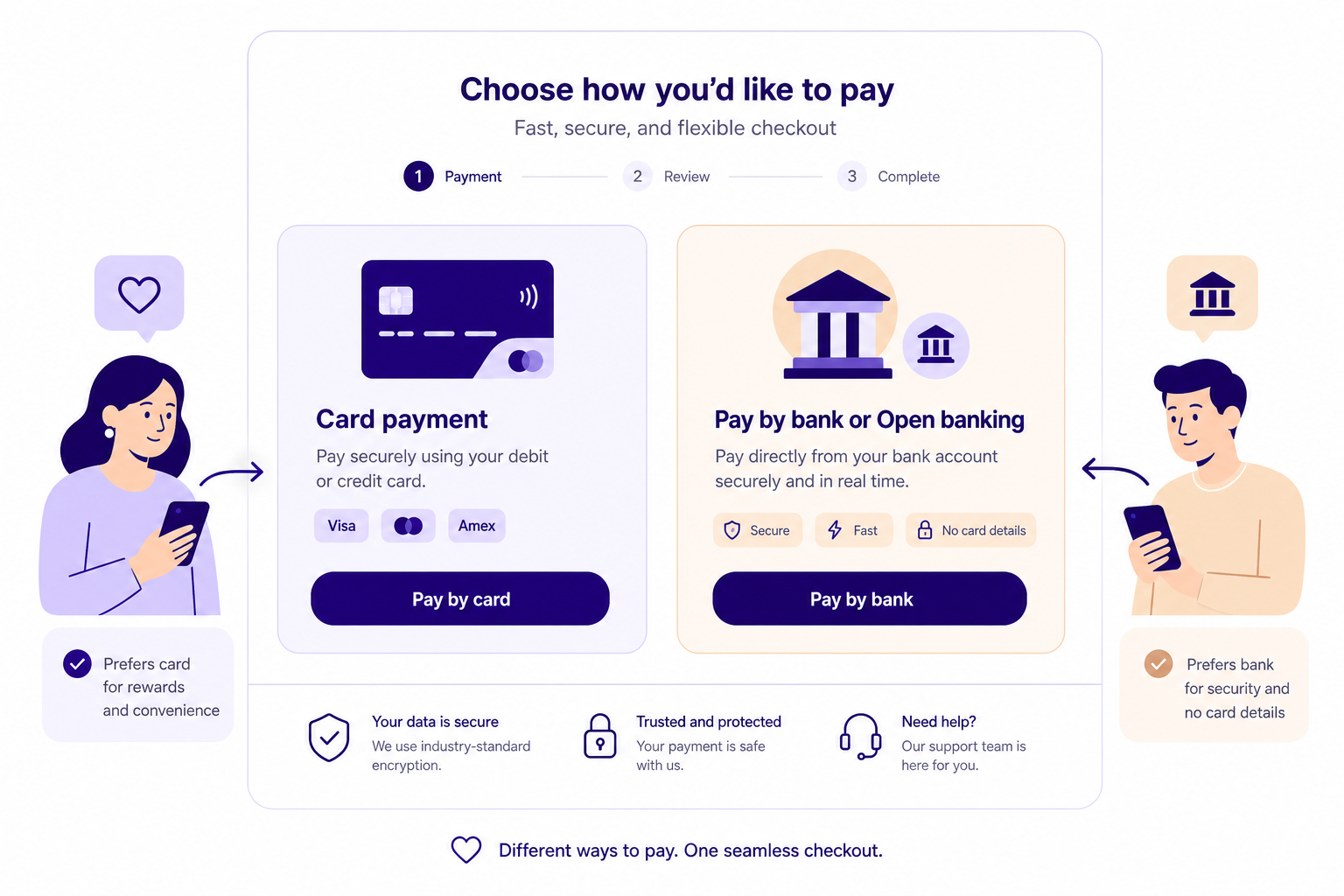
For high-ticket items, wholesale orders, or digital services where transaction fees are high, steering customers toward open banking can protect your margins. For fast, low-value retail checkouts, keeping cards or digital wallets active ensures you do not lose impulsive buyers to checkout friction.
If you want to offer your customers direct, secure bank payments alongside traditional card options, Montonio's payment solution provides a unified setup. Our infrastructure allows you to accept bank payments, cards, and regional payment methods through a single checkout integration.
Additionally, for operations that occur outside of a standard online checkout, you can use Montonio's payment links to collect deposits or unpaid invoices via email and SMS. To help you master this format, we have put together a guide on getting paid faster with payment links. If you require custom workflows, our custom API gives you the flexibility to build tailored payment and refund experiences directly into your existing systems.
To explore how open banking and instant bank transfers can lower your transaction costs and improve your settlement times, contact our team today to discuss the right integration for your business.