Bank payments vs card payments: Cut checkout fees by up to 85%
Accepting the right mix of payment methods directly impacts your profitability and customer retention. Bank payments settle almost instantly and can cut your transaction fees by up to 85%, while card payments remain essential for capturing international buyers and enabling mobile wallets. Balancing both options allows you to minimise processing fees without causing friction at checkout.
The difference between bank and card payments
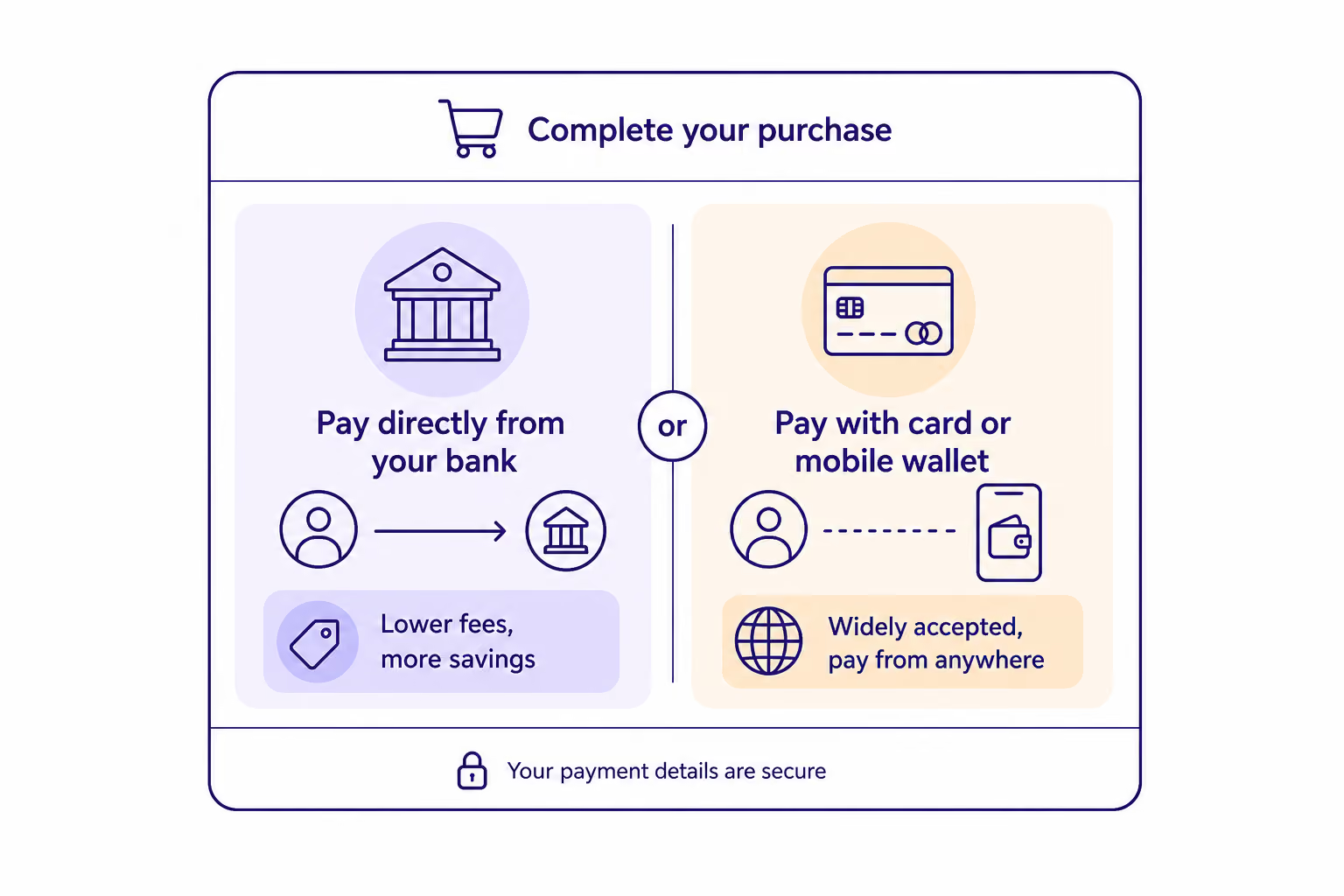
While both methods transfer funds from a customer to your business, they operate on entirely different financial rails.
What are bank payments
Bank payments allow customers to pay directly from their bank account to yours. Using secure account-to-account (A2A) infrastructure, the buyer is redirected to their own online banking environment to approve the payment. This is a direct "push" transaction, meaning the customer authorises the exact amount to be sent to your account immediately. These bank transfers bypass traditional card systems entirely, making them highly secure and cost-effective.
What are card payments
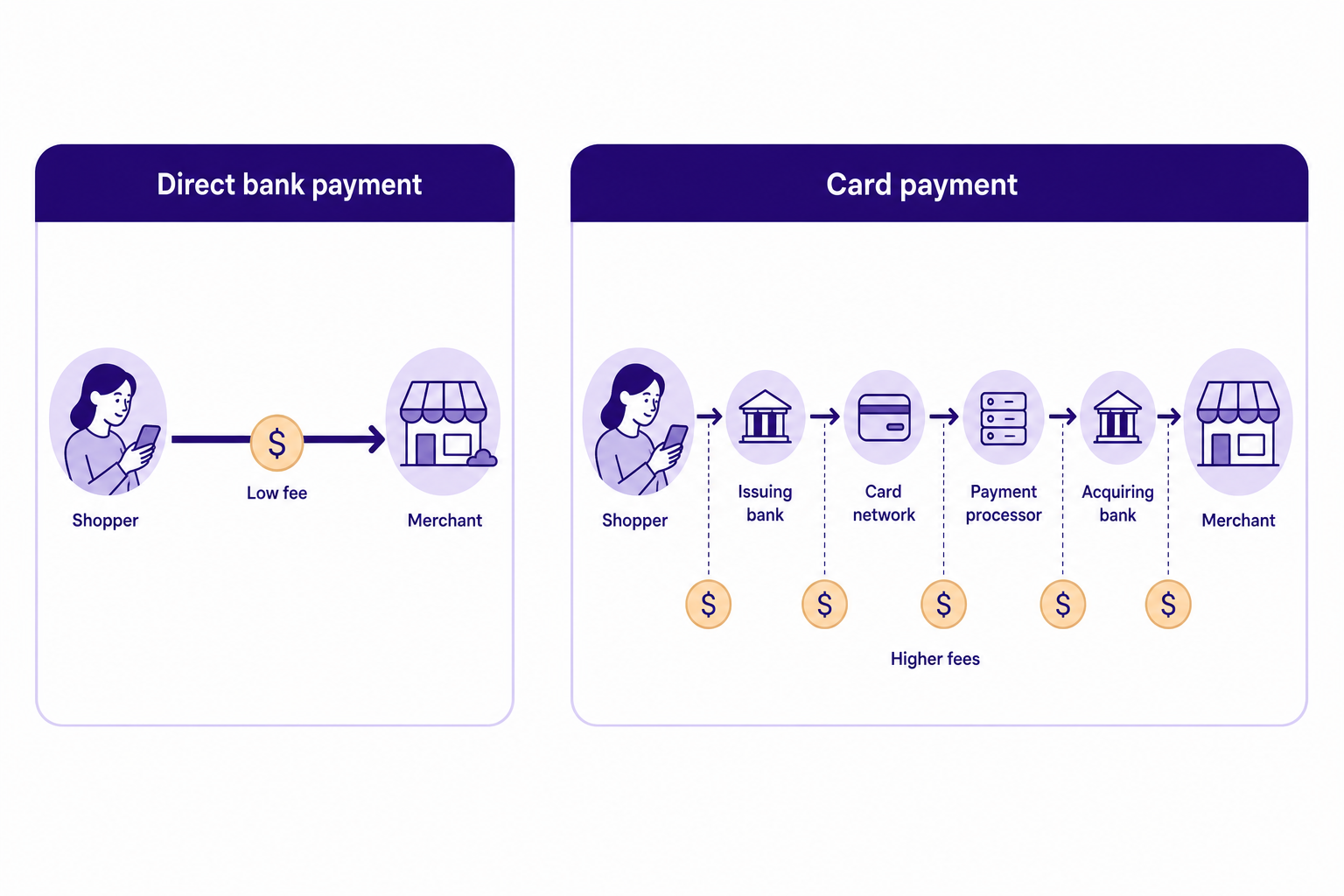
Card payments rely on the traditional card network ecosystem, involving issuing banks, acquiring banks, and card brands like Visa and Mastercard. When a customer enters their card details, a gateway encrypts and transmits the data to check if funds are available. You can learn more about how a payment gateway works to secure these transmissions behind the scenes. Unlike bank payments, card transactions are "pull" mechanisms where your financial partner requests money from the customer's account.
How the financial structures differ
Acceptance costs are often the most significant differentiator between these two payment methods. Understanding how fees are charged helps you accurately calculate your net margins.
Card payment fees and the multi-layered model
Card transaction fees are dynamic and complex. Every card transaction carries multiple fees, including interchange fees, scheme fees, and gateway processing costs.
- Card payment pricing consists of a fixed fee plus a dynamic percentage depending on the specific card type.
- Processing fees are automatically deducted from your revenue before payouts are settled to your bank account, which is shown under the deductions section of your invoice.
Bank payment fees and the flat-rate alternative
Because bank payments bypass card network intermediaries, their pricing is much simpler and more transparent.
- Bank payment transactions incur a low flat fee or a minimal percentage rather than multi-layered network charges.
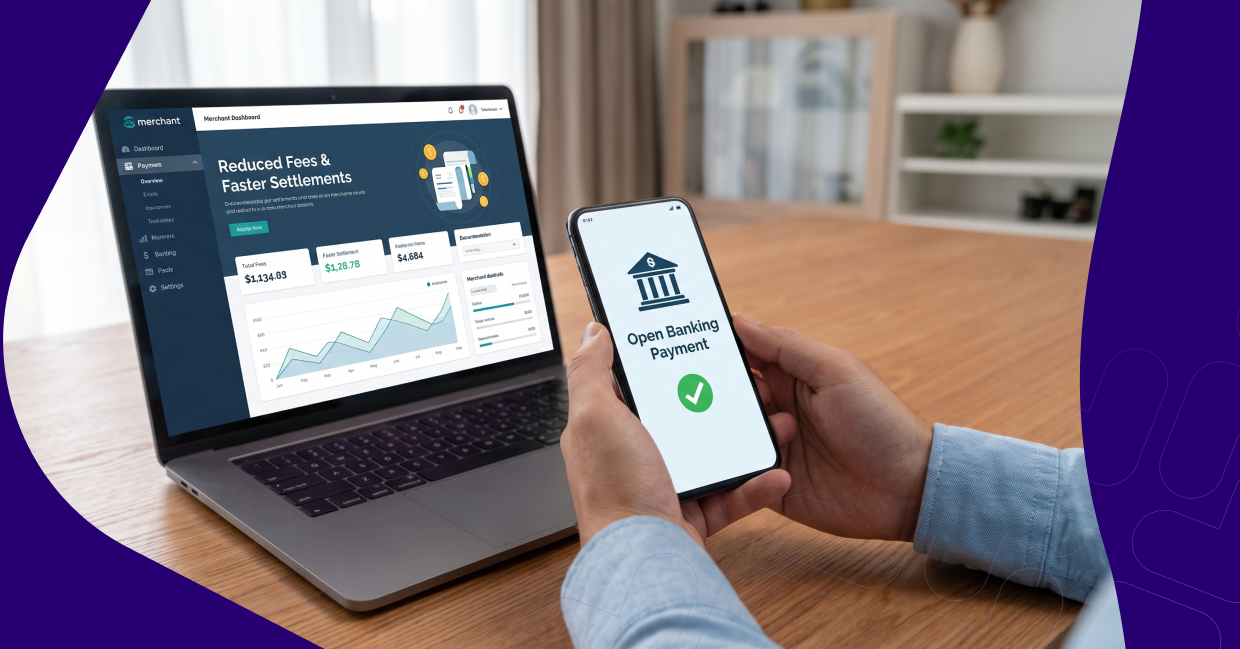
- Processing costs are billed separately on a standard invoice instead of being deducted automatically from your payouts, allowing you to receive 100% of your sales value instantly.
According to a Federal Reserve analysis, direct pay-by-bank transactions can reduce merchant acceptance costs by 40% to 85% compared to credit cards.
Speed, settlements, and cash flow
The time it takes for money to move from your customer's account into your business bank account has a major impact on your daily working capital.
- Bank payment speed: Bank payments clear almost immediately. Because the funds are pushed directly from the buyer’s account to yours, you gain immediate access to your capital, which simplifies inventory management and shipping fulfillment.
- Card payment speed: While card payments are authorised in seconds, the clearing process takes longer. It typically takes one to three business days for funds to clear to your bank account.
Many merchants wonder if instant bank settlements complicate the refund process. In reality, issuing refunds for bank payments is straightforward. Within the Montonio Partner System, you can navigate to "Store settings → Products" and click "Activate Bank payment refunds" to return funds directly to your customer's bank account.
Security, chargebacks, and risk
Fraud protection and payment disputes present different challenges depending on the transaction type.
The card payment chargeback risk
Card payments expose merchants to chargeback liability. Under consumer protection rules, cardholders have up to 60 days to report a dispute to their issuer. If a cardholder claims fraud or a non-delivered order, the merchant faces a 20-to-45-day window to submit evidence to fight the dispute.
In card-not-present (CNP) transactions, the merchant is usually liable for restitution, and you will be assessed a chargeback fee regardless of the dispute's outcome.
The security of bank payments
Bank payments dramatically reduce fraud risk. Since bank transactions require customers to log directly into their banking app – often requiring biometric verification like Face ID or fingerprint scans – the transaction is highly authenticated.
Because the payment is initiated directly by the payer through their bank, the standard card chargeback process does not exist. This gives you peace of mind that a completed sale is final.
Balancing checkout conversion and user preference
Even though bank payments are cheaper and settle faster, you cannot rely on them alone. Forcing customers to use a payment method they dislike will cause them to leave your site.
Research by the Baymard Institute reveals that 10% of online shoppers abandon checkouts because there were not enough payment methods available. To prevent this, offering a balanced mix of both payment types is essential.
- Why card payments are still vital: Card payments offer unmatched global reach. While bank payments are highly popular in regional markets like Poland, the Baltics, and Finland, why card payments are still important lies in their ability to capture international customers who do not have access to local bank accounts.
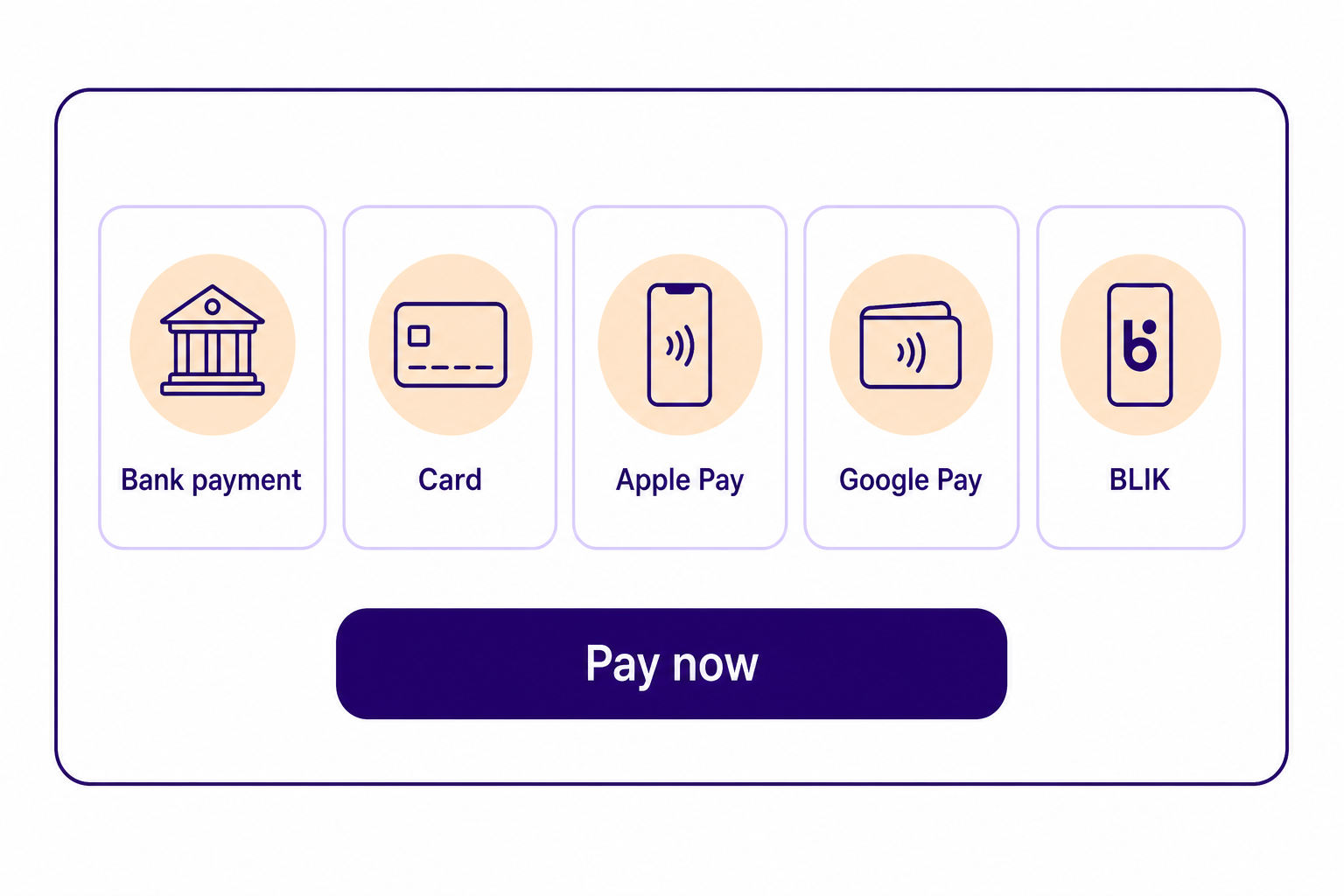
- The power of digital wallets: When you accept card payments through a modern gateway, you also unlock digital wallets. Integrating swift payment methods like Apple Pay and Google Pay allows shoppers to skip manual card entry entirely, completing purchases in seconds. In Finland, the same card setup also unlocks MobilePay, which over 2.86 million Finns use to pay online.
Offering the right local and international options at checkout is one of the most reliable ways to boost your online store's conversion rate.
Comparing bank and card payment features
Choosing the right mix for your checkout flow
Designing a checkout flow requires balancing customer convenience with operational costs. Whether you implement a one-page checkout versus a multi-step checkout, your payment options must load quickly, feel highly secure, and offer clear choices.
Presenting too many payment methods can overwhelm your customers, while offering too few will increase friction. Providing the right payment methods is key to reduce cart abandonment and keep customers moving forward.
When picking an ecommerce payment provider, look for a partner that lets you accept both local bank payments and card payments through a single integration. If you use a custom platform, you can connect these services using a flexible custom API to maintain full control over your checkout experience.
With Montonio, you can accept bank payments, card payments, MobilePay, Apple Pay, Google Pay, and local methods like BLIK all in one place. This balanced approach helps you keep payment processing fees low while keeping conversion rates high.
Ready to optimise your checkout? Explore how Montonio's payments platform can help you cut transaction fees and boost your sales today.