Track the 6 ecommerce KPIs that drive store revenue
To build a sustainable ecommerce brand, you must focus on six core metrics:
- Conversion rate
- Average order value
- Cart abandonment
- Customer lifetime value
- Customer acquisition cost
- Return rate
Monitoring these key performance indicators (KPIs) reveals exactly where your checkout leaks revenue, how efficiently your marketing budget operates, and where delivery bottlenecks slow your growth.
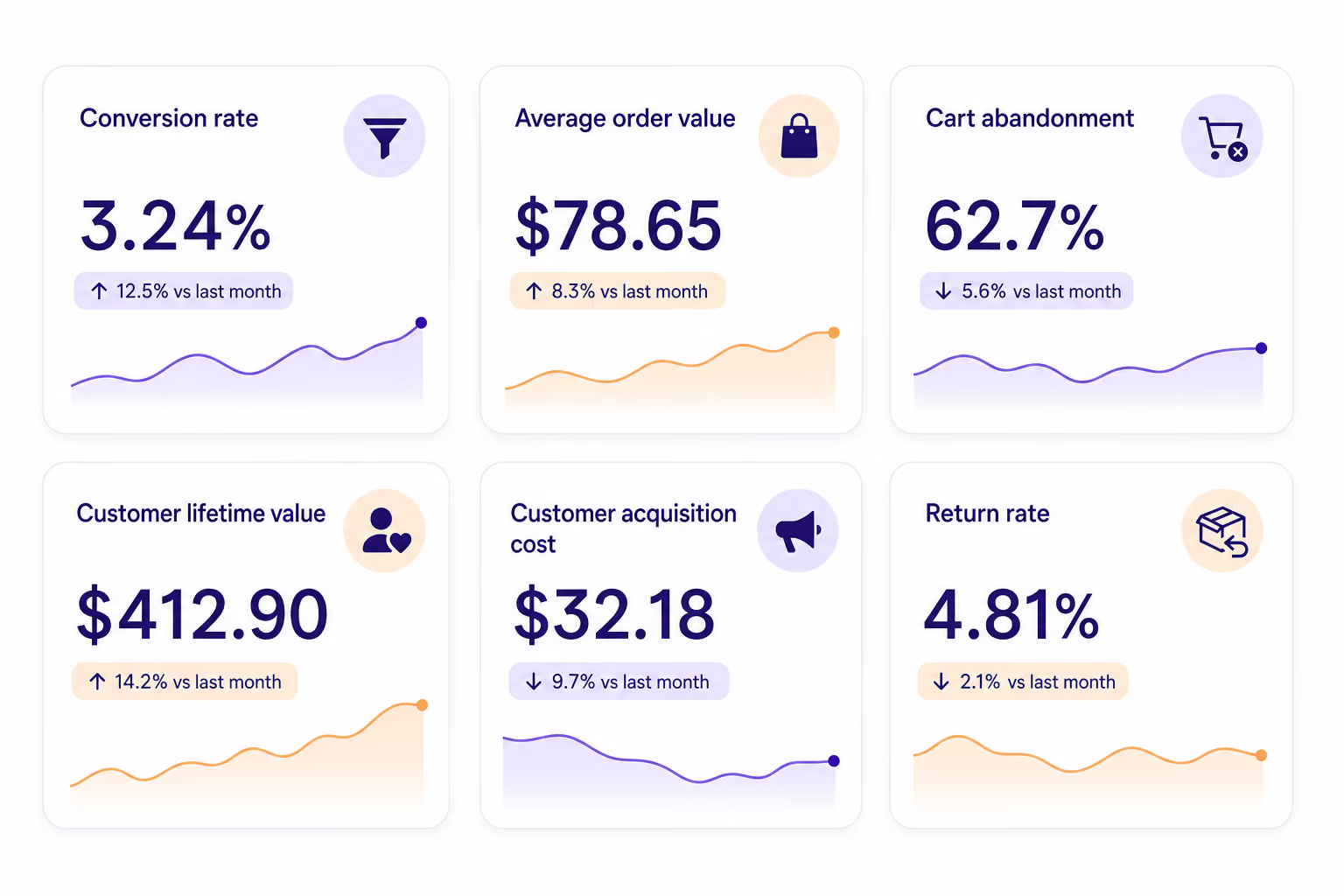
Monitoring dozens of metrics seems thorough, but it usually leads to analysis paralysis. While tracking micro-interactions can offer niche insights, focusing on these six critical KPIs provides the strategic clarity required to scale operations without getting bogged down in noise.
Ecommerce conversion rate
Ecommerce conversion rate measures the percentage of website visitors who complete a purchase. In Google Analytics 4, this conversion rate is used to measure the success of your sales funnel.
Why it matters
A low conversion rate suggests friction in the user journey. While you might assume a low conversion rate is simply a marketing issue, more traffic will not fix a broken user experience. If users struggle to navigate your pages or complete their payments, increasing your marketing budget only sends more people to a leaky bucket.
How to improve it
- Reduce page load speeds to avoid frustrating users.
- Simplify the customer journey by offering guest checkout options.
- Support mobile-first payment methods like Apple Pay, Google Pay, and for Finnish shoppers, MobilePay.
Improving your load speed by just one second can lift your conversions. You can discover more high-impact strategies in our guide to ecommerce website optimisation. Additionally, omitting forced account creation removes a major barrier for first-time buyers, helping you avoid common ecommerce mistakes that hurt sales. For a deeper breakdown of checkout enhancements, explore these 5 ways to boost your online store conversion rate.
Average order value
Average order value (AOV) represents the average amount of money a customer spends when placing an order.
Why it matters
Increasing your AOV is highly efficient because it leverages existing traffic, boosting revenue without raising customer acquisition costs. By encouraging customers to spend more during a single session, you extract more margin from the same volume of visitors.
How to improve it
- Implement cross-selling and up-selling modules on product and checkout pages.
- Encourage larger carts by establishing free shipping thresholds.
- Introduce flexible payment options like interest-free instalments at checkout.
Allowing customers to split their purchases or defer payments helps them manage their budgets comfortably. When customers have access to flexible financing, they are more willing to add premium items to their carts. You can implement this by offering a transparent Pay Later option during checkout.
Shopping cart abandonment rate
The shopping cart abandonment rate measures the percentage of shoppers who add products to their cart but leave your store without completing the transaction.
Why it matters
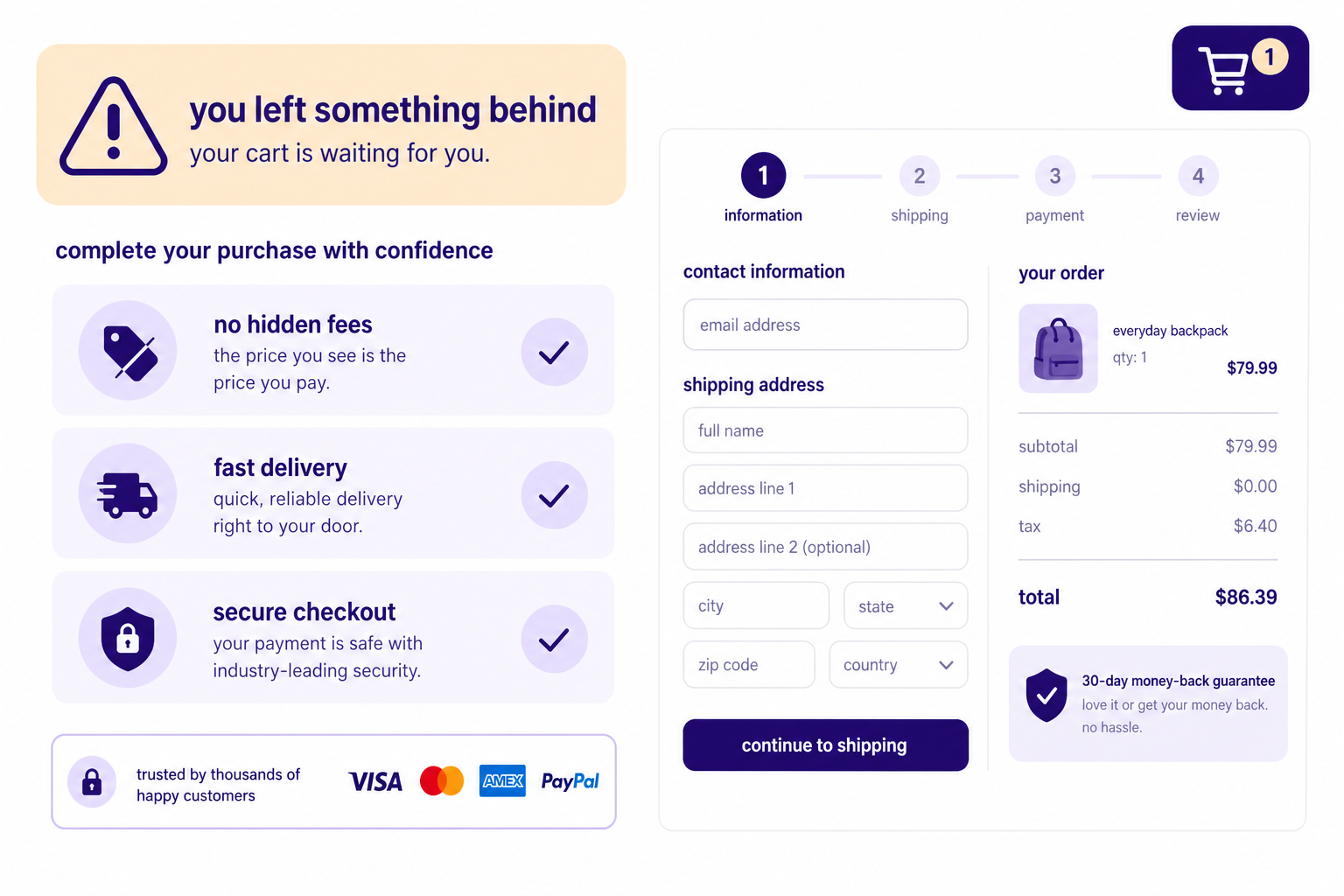
According to checkout usability research by the Baymard Institute, the global average online shopping cart abandonment rate stands at 70.22%. This represents a massive pool of lost revenue. While some abandonment is natural browsing behaviour, much of it stems from administrative or design friction at the final checkout step.
How to improve it
- Display all shipping costs and extra fees upfront to eliminate surprises.
- Use autocomplete features to shorten complex address forms.
- Integrate localized checkout options like BLIK and local bank payments.
Hidden costs at the end of the journey trigger immediate drop-offs. If you want to keep shoppers engaged, you can find practical solutions in our detailed guide on how to reduce cart abandonment. Furthermore, setting up a reliable payment gateway that supports the exact payment methods your customers prefer reduces friction and builds trust.
Customer lifetime value
Customer lifetime value (CLV) is the total revenue your business expects to earn from a single customer over the entire duration of their relationship with your store.
Why it matters
Acquiring new customers is expensive. Retention marketing is financially attractive because acquiring a new customer can cost up to five times more than retaining an existing one. Furthermore, existing customers spend 67% more on average than new buyers, making CLV a critical metric for long-term survival.
How to improve it
- Launch automated retention campaigns to target previous buyers.
- Provide complete visibility over parcel delivery stages with live tracking.
- Draft a clear and fair return policy to build customer trust.
Building post-purchase trust is central to driving repeat business. If buyers feel secure knowing they can easily send back items that do not fit, they will return to buy from you again. To structure this effectively, read our perspective on why a return policy can make or break your online store.
Customer acquisition cost
Customer acquisition cost (CAC) measures the total sales and marketing spend required to secure a single new customer.
Why it matters
If your CAC is close to or higher than your CLV, your business will lose money. Many ecommerce benchmarks suggest that a healthy target is a CLV-to-CAC ratio of 3:1. This means the lifetime value of a customer should be roughly three times the cost of acquiring them.
How to improve it
- Invest in organic search engine optimisation to generate sustainable traffic.
- Optimize checkout conversion rates to convert paid traffic more efficiently.
Relying entirely on paid advertisements leads to climbing acquisition costs. By diversifying your traffic channels, you can acquire high-intent visitors at a much lower cost. Discover how to build sustainable organic channels in our overview of how to increase ecommerce traffic.
Return rate
The return rate measures the percentage of shipped orders that customers send back to your store for an exchange or refund.
Why it matters
High return rates quickly erode profit margins. Processing returns requires manual support, shipping fees, and inventory restocking costs.
How to improve it
- Write precise product descriptions and upload high-resolution images.
- Offer diverse delivery methods such as local parcel lockers and couriers.
- Streamline the refund process using automated merchant tools.
- Eliminate mistakes when sending out products by using pick and pack tools
Setting accurate customer expectations reduces the likelihood of returns. When returns do occur, handling them swiftly keeps customers satisfied and encourages future orders. You can read more about managing fulfillment logistics in our guide to understanding shipping costs. When you need to process refunds, using a service like Montonio Refunds allows you to manage everything directly from your admin panel, reducing manual administration.
How to turn metric insights into store growth
Data is only useful if you act on it. If your conversion rate is low or your cart abandonment is high, the solution lies in optimising your checkout flow and providing better shipping and payment options.
By upgrading your payment infrastructure, simplifying your checkout fields, and handling logistics smoothly, you can systematically improve all of these core KPIs. We built Montonio to help online businesses across the Baltics, Poland, and Finland streamline their payments and shipping. Our platform integrates bank links, card payments, Pay Later options, and carrier management into a single, seamless checkout.
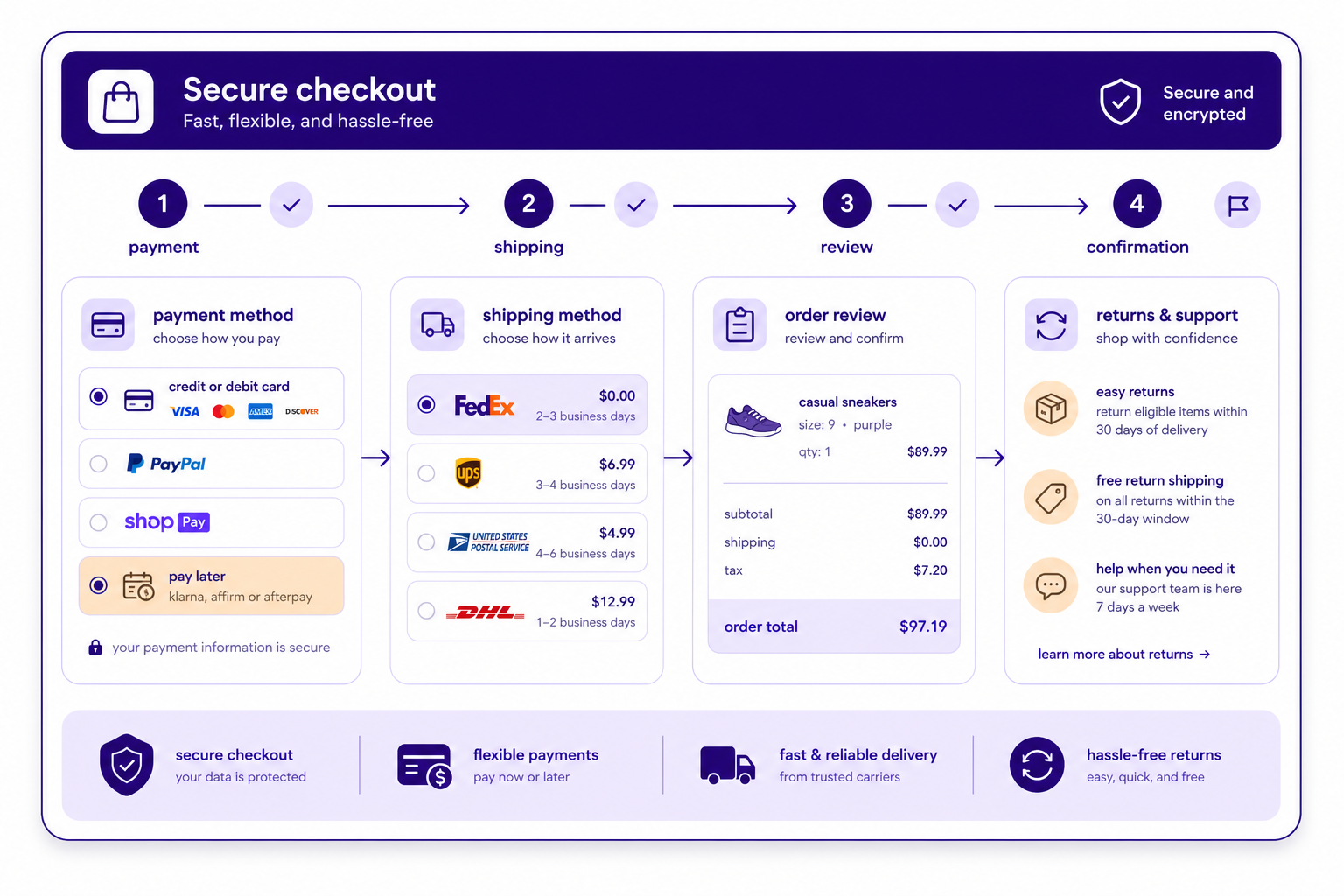
Learn more about how Montonio shipping and checkout integrations can help you lower checkout friction and grow your store.