How to cut ecommerce shipping costs and protect your margins
High shipping fees are the primary reason online shoppers abandon their purchases. Research from the Baymard Institute reveals that the average checkout abandonment rate is around 70%, with 39% of those shoppers leaving because extra costs like shipping, taxes, and fees are too high. To protect your profit margins and keep your conversion rates stable, you must actively manage your outbound shipping expenses. You can lower these costs by auditing your shipping data, right-sizing your packaging, adopting multi-carrier strategies, and structuring profitable free-shipping thresholds.
You might worry that negotiating rates or altering your logistics is only viable for retail giants with massive order volumes. While larger brands naturally start with deeper volume discounts, small ecommerce merchants can still use targeted operational changes to level the playing field without sacrificing delivery speed or customer experience.
How auditing shipping data unlocks lower carrier rates
Many carriers offer volume-based discounts and are willing to negotiate with growing businesses that demonstrate clear potential. To build a strong negotiating position, you need to understand your shipping profile and present data-backed arguments to potential carriers.
Prepare for negotiations by taking these systematic steps:
- Gather your historical shipping volumes, parcel dimensions, and destinations to pinpoint your primary cost drivers.
- Benchmark your current carrier pricing against industry standards to identify areas where you are overpaying.
- Request targeted concessions such as reduced fuel surcharges, adjusted dimensional weight divisors, or zone-based discounts.
- Negotiate with multiple national and regional providers simultaneously to foster competitive bidding.
- Review carrier invoices regularly to identify billing errors and document recurring fee patterns.
- Schedule annual contract reviews to adjust your pricing terms as your outbound volume grows.
Showing carriers that you regularly monitor your shipping data proves you are an informed partner, which increases your leverage during contract negotiations.
Optimising your packaging to beat dimensional weight pricing
Carriers do not just look at how heavy a package is when calculating rates; they also measure how much space it occupies in their vehicles. This practice, known as dimensional or volumetric weight pricing, can significantly increase your shipping bills if you send small items in oversized boxes. To avoid paying to ship empty air, you must start by understanding how shipping costs are calculated.
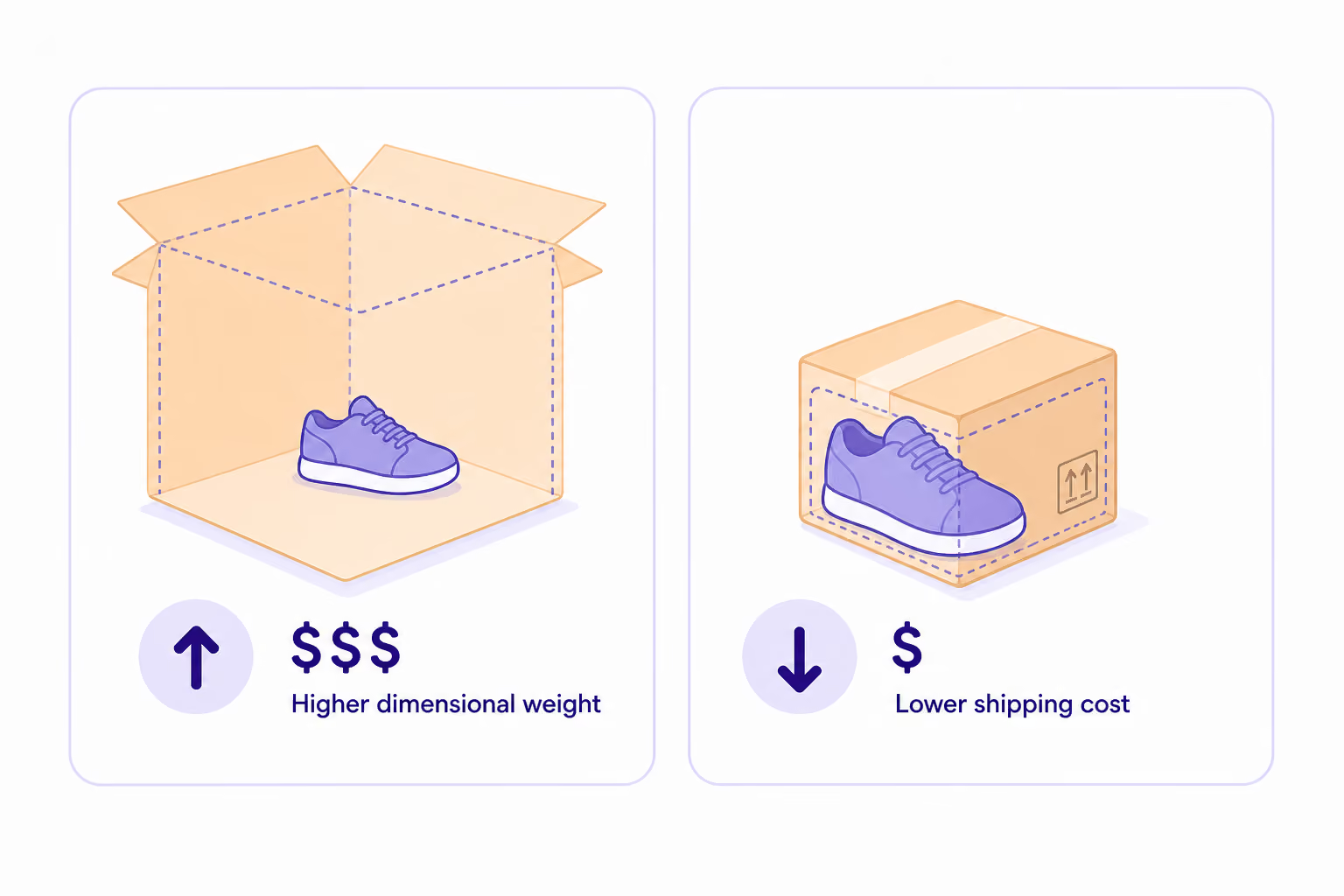
National and international carriers use specific formulas to determine billable weight. If the dimensional weight is higher than the actual physical weight of the package, you are billed for the larger dimensional weight.
To shield your business from these hidden packaging fees, apply these best practices:
- Select right-sized boxes or padded mailers to eliminate empty space and avoid dimensional weight surcharges.
- Utilise carrier-supplied flat-rate boxes to lock in predictable shipping costs for heavy, compact products.
- Limit the use of oversized or nonstandard packaging that triggers automated handling fees.
Using carrier-supplied flat-rate boxes can be highly economical. The price is fixed regardless of the weight, making it a predictable option for heavy items that fit into standard dimensions. For example, FedEx bases its charges on whichever weight is greater, while USPS charges nonstandard fees for packages exceeding 22 inches in length.
Why a multi-carrier strategy reduces delivery costs
Relying on a single shipping carrier exposes your business to sudden price hikes, capacity limits, and unexpected service delays. Implementing a multi-carrier shipping strategy allows you to compare rates in real time, build supply chain resilience, and select the fastest, most cost-effective option for every single parcel.

Instead of manually navigating multiple carrier websites, you can use automated shipping software to simplify the process. An all-in-one shipping platform integrates major carriers into a single dashboard. This consolidated setup gives you access to pre-negotiated, exclusive shipping rates that are typically reserved for high-volume merchants, helping you keep delivery costs low from day one.
Accessing pre-negotiated carrier rates through a consolidated platform bypasses the need for high-volume minimum commitments, giving smaller merchants instant access to competitive shipping discounts.
Through integrations like Unisend by Montonio, you can easily reach customers across Lithuania, Latvia, and Estonia with competitive next-day delivery. If you ship from Finland, you can connect your own Matkahuolto, Posti, PostNord contract to deliver within Finland and to Sweden, Norway, and Denmark. To save time on daily operations, you can also use automated label management tools to generate, edit, and print shipping labels in bulk directly from your orders, eliminating manual data-entry errors.
Placing inventory closer to your customers to cut transit fees
If you ship all your orders from a single warehouse, your shipping costs will rise whenever you send packages to distant regions. Shipping carriers divide geographical areas into shipping zones; the further a package must travel from your fulfilment centre, the higher the shipping zone, transit time, and overall delivery cost.
To reduce travel distances and lower your shipping zones, consider splitting your inventory across multiple regional warehouses or partnering with a third-party logistics provider. Strategically placing your inventory near major transit hubs or highly populated customer hubs shortens delivery routes and cuts transport expenses.
Furthermore, collaborating with a third-party logistics partner gives you access to their negotiated bulk shipping rates, which can dramatically lower your per-package cost. This approach is especially valuable if you are expanding into international ecommerce shipping, where customs clearance, cross-border taxes, and long-distance logistics can otherwise become prohibitively expensive for a small business.
How to calculate a profitable free-shipping threshold
While offering free shipping is one of the most effective ways to lower cart abandonment, absorbing the entire cost of delivery can quickly wipe out your profit margins. To prevent this, you should set a strategic free-shipping threshold that encourages customers to buy more while ensuring your business remains profitable.
To design a profitable free-shipping threshold, structure your policy using these key rules:
- Set your free-shipping threshold slightly above your median order value to encourage larger baskets.
- Exclude low-margin, heavy, or oversized items from your free-shipping policy to protect profit margins.
- Run A/B tests over two- to three-week cycles to identify the ideal threshold for your target audience.
- Promote your free-shipping threshold using highly visible banners and cart progress bars across your website.
To make this strategy work, you must calculate your exact unit economics. Determine your average shipping cost, average order value, and gross profit margin to identify exactly how much margin you can afford to allocate to shipping.
Additionally, you can offset shipping costs by designing a balanced ecommerce return policy. For example, you might offer free return shipping only if the customer chooses store credit or an exchange, whilst requiring them to cover the return delivery fee for standard cash refunds.
Lowering your shipping expenses does not require you to compromise on delivery speed or customer satisfaction. By auditing your carrier contracts, optimising package dimensions, adopting a multi-carrier platform, and establishing smart free-shipping thresholds, you can protect your business margins and create a reliable, cost-effective checkout experience.
To see how you can manage multiple carriers, print labels in seconds, and keep your customers informed, use Montonio tracking tools to gain full visibility over your entire shipping workflow today.