Making therapy accessible: How GoTherapy scaled its platform by automating payments
GoTherapy is a Lithuanian mental health platform that helps people find verified therapists, helps independent therapists attract new clients and grow their practices, and enables employers to fund all or part of their employees’ therapy costs.
The idea for GoTherapy came from a simple observation: finding a therapist often takes the most effort exactly when someone has the least energy to give. The platform launched in 2024 to close that gap. Since then it has built a network of 50+ verified therapists and facilitated over 6,000 sessions.
The same problem from three sides
For someone struggling to get through the day, the search itself is the obstacle. Browsing several websites, contacting therapists one by one, and waiting to hear back on price and availability can feel overwhelming. Some platforms add another barrier: lengthy questionnaires that ask people to disclose deeply personal information before they can even see who they might speak with.
Therapists face it from the other direction. Alongside supporting existing clients, an independent therapist has to market their practice, answer enquiries, schedule sessions, send details and reminders, collect payments, and issue invoices. Every one of those tasks pulls time and attention away from the actual work with clients.
Employers, especially small and medium-sized businesses, face a third version. Some rely on a single psychologist for the whole team, which limits both choice and privacy. In other setups, employees have to ask HR for approval or submit therapy expenses for reimbursement, revealing that they sought support in the first place. And plenty of employers want to help but cannot afford to cover every session in full.
Bringing all three onto one platform
GoTherapy was built to address all three issues at once.
Clients can browse every verified therapist before sharing personal information, comparing qualifications, experience, therapeutic approaches, prices, and real-time availability, then book an online or in-person session directly, with no matching questionnaire.
Therapists get client acquisition and practice management in one place. They set their own services, prices, and working hours, keep full control of their practice, and receive one consolidated monthly payout for every completed session. The platform handles the rest, automating all bookings, payments, and administrative tasks.
Employers can set up a therapy benefit in under 15 minutes, at any team size. They choose how many sessions to support and cover any share of the cost, from 1% to 100%. Because employees are recognised by their work email, the right contribution applies automatically to their private bookings, with no HR approval or reimbursement claims. Employers pay only for the sessions employees actually attend.
The cost of keeping that promise
The promise to therapists, that GoTherapy would handle payments, invoicing, and payouts, is where scale got complicated. Delivering it meant the whole journey, from booking to payment, had to stay simple for clients and manageable for therapists. As GoTherapy grew, payments became the biggest obstacle to that.
Before Montonio, each therapist collected payments directly from clients. They sent their bank details, checked incoming transfers, matched payments to sessions, issued invoices, and handled refunds themselves. GoTherapy then gathered payment records from every therapist, reconciled them against bookings, and calculated its commission by hand.
That held up with a small network, but as it grew to dozens of therapists, it turned fragmented and slow. Every new one added another separate payment flow and more manual work for both the therapist and the GoTherapy team. Payment had to become part of the booking itself, with each transaction linked automatically to the correct client, session, and professional.
One integration, multiple markets
GoTherapy compared several payment providers, but it was already planning beyond Lithuania. The goal is an international therapy platform, which meant the payment infrastructure had to support that expansion without a fresh integration in every country.
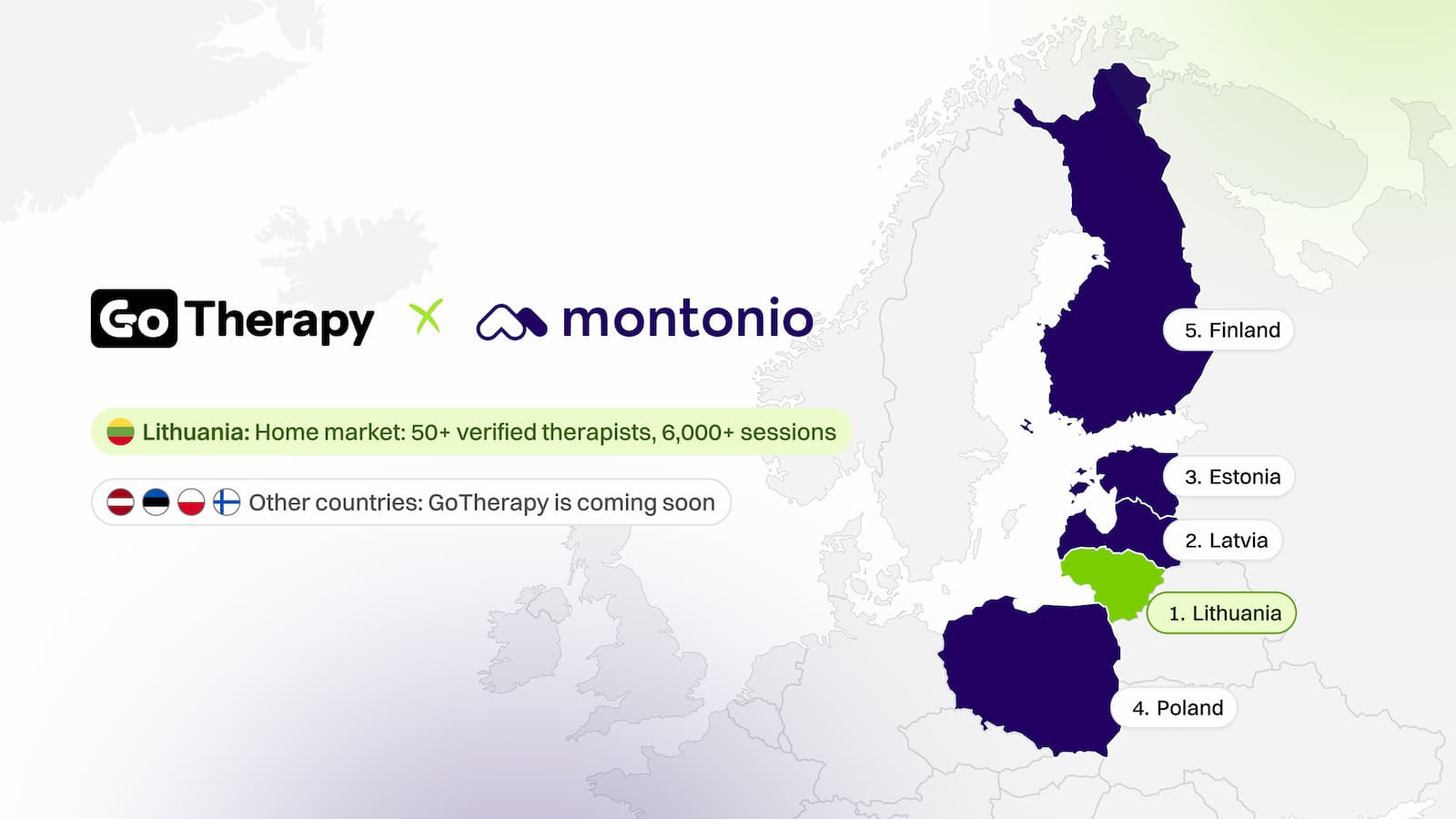
Montonio's coverage across the Baltics, Poland, and Finland made it the best fit. One integration opened five markets and let clients pay through the local methods they already use, a practical foundation for the next stage of growth into neighbouring countries, and over the longer term, across Europe and beyond.
What changed day to day
With Montonio, payment became part of the GoTherapy booking flow. When a client pays, the platform links the transaction to the correct session and therapist and confirms the booking immediately. Therapists no longer send bank details, check accounts, or match transfers by hand.
Clients book and pay in one continuous step using online banking, payment cards, Apple Pay, or Google Pay. Therapists are out of the payment business entirely, while the GoTherapy team runs transactions, refunds, invoices, and commissions through one central system instead of piecing together records from every therapist.
GoTherapy now processes more than 400 client payments through Montonio each month. The integration saves the team several hours of manual work a month and cuts payment errors and support requests. As payment volume grows, the administrative workload no longer grows with it.
What's next for GoTherapy
With payments handled, the team has more time for the mission behind the platform: making therapy easier to find and afford. People can choose a therapist privately and with confidence. Therapists can support more clients without shouldering every administrative task alone. Employers can make therapy more affordable even when they cannot cover the full cost. The larger aim is for fewer people to give up on finding help because the process feels too difficult, too expensive, or too uncertain.
That means expanding the therapist network, improving the client experience, and bringing GoTherapy to new markets, with payments running quietly in the background rather than holding the platform back.

.png)